A little bit of history
The idea of forming a bowls club in West Hoathly was formulated in the Autumn of 1910 by Mr N. A. Block who at that time owned the Manor House in the centre of the village. The Club did not have its own green at first but it was able to use the grass tennis courts at the Manor House by the kind permission of Mr Block.
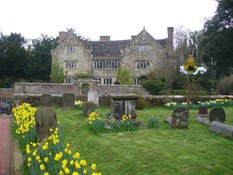
The Manor House
The first recorded game took place on 16th September 1911 when West Hoathly entertained East Grinstead. The match was reported by the local East Grinstead newspaper as follows:
West Hoathly vs East Grinstead
The East Grinstead team visited West Hoathly to play the newly formed club there on Saturday at the invitation of Mr. Block. The game was played on the tennis courts at the Manor House, and the visitors won by 33 points. Both teams were kindly entertained to tea by Mr. Block and a most enjoyable afternoon was spent.
This started what was soon to become something of a tradition as East Grinstead kept winning home and away for a period of more than 20 years!
It is interesting to note that nearly all fixtures had one thing in common and that was access to one of the then the two railway lines that intersected at East Grinstead giving both North : South and East : West routes that could be used from West Hoathly Station. Thus, in addition to East Grinstead, we played at Newick, Barcombe, Lewes, Newhaven, Brighton, Tunbridge Wells, Groombridge, Crawley, Horsham, etc. Anywhere else & you had to go on your bike! It probably explains why there has never been a green at Ardingly - no station & too many hills.
In the dark days of the Great War, the Parish of West Hoathly lost many fine young men. One of these was Charles Victor Cole who lived in Melchbourne Villas next to the the Village Hall. Mr Cole was the Secretary of the Bowls Club before enlisting. His name is recorded on the Roll of Honour website details of which are reproduced below by kind permission. This website preserves the memory of the millions of of UK personnel killed in the Great War of
1914-1918.
For more information on other victims of the Great War from West Hoathly and throughout Sussex please visit
http://www.roll-of-honour.com/Sussex/WestHoathly.html
Private G.41291, 22nd Battalion, The Royal Fusiliers, 2nd Division. Killed in action near Loos on 29th April 1917. Aged 38. Son of Herbert George & Mary Cole, husband of Minnie Mary Cole of 3 Melchbourne Villas, West Hoathly. Chorister at the Parish Church, and Hon. Secretary of West Hoathly Bowls Club. Born in Hove and enlisted in East Grinstead. Buried Orchard Dump Cemetery, Arleaux en Gohelle F.777
The Manor House provided the venue for most home matches for the next twenty years but it came to an end when Mr Block wanted the tennis court for his children to play tennis.
Fortunately, help was at hand and a plot of land was generously donated by the Clarke family from nearby Highbrook.
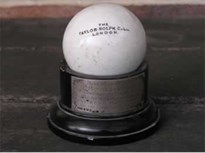
The new green was opened on 1st June, 1935 with the first jack being bowled ceremoniously by a Mr. W H Shelford. The original jack that was used is on display at the Club today. The new green was a sporting 4 rinker that continued to be used for nearly 50 years except for a period in World War II when there were insufficient players to keep the green open. When the green reopened after the War, it was reported that the grass was more than 3 feet (1 metre) high!
Not long after acquiring the green, a suitable building was acquired to be used as a pavilion. The old green hut continued to be used until the early 1980s with few changes other than the addition of a bar in the 1970s. The bar soon increased the income of the Club and significant investment started to be made in the Club's facilities.
One unusual feature of the Club's membership in the 1970s & 80s was the preponderance of young bowlers many of whom were members of the highly successful West Hoathly Football Club. Another feature of the Club's membership was a distinct bias towards people from the building industry. This combination of youth and practical skills led to two ambitious projects being started in 1981/82
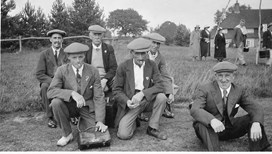
Waiting to Play!